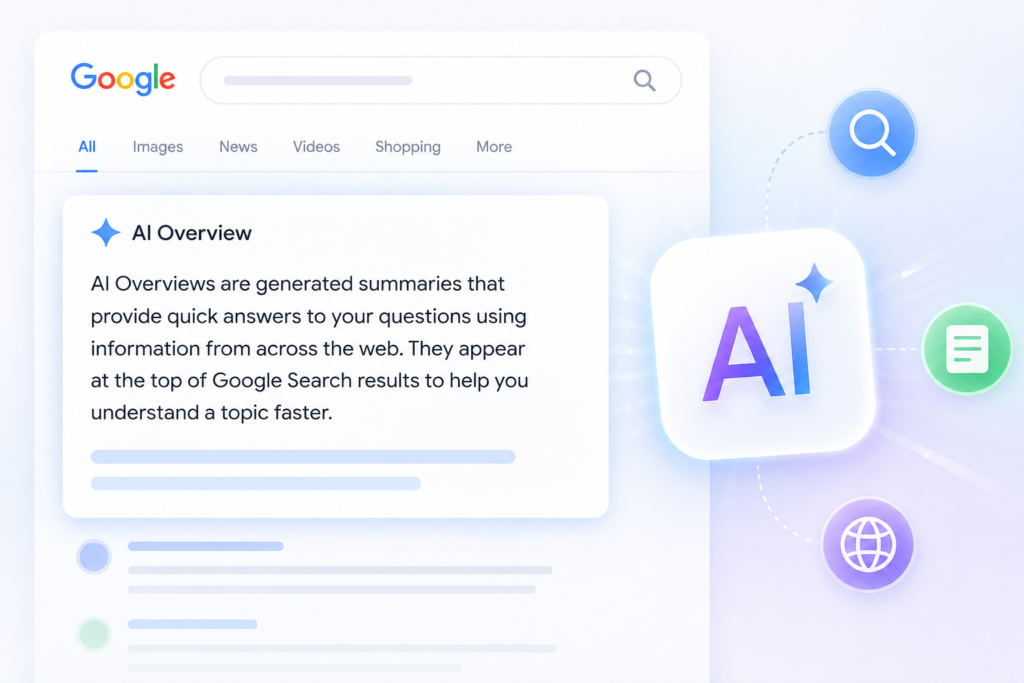
If you’ve searched anything on Google recently, you’ve probably already seen one — a box near the top of the results page that gives you a written answer before you even see a single website listed. That’s an AI Overview, and it’s quietly become one of the biggest changes to search in years.
I want to break this down simply, because I think a lot of business owners have heard the term thrown around without anyone actually explaining what it means for them.
So what exactly is an AI Overview?
An AI Overview is a summary that Google generates using AI, pulling information from multiple websites to answer your question directly on the results page. Instead of showing you ten blue links and letting you click through to find your answer, Google increasingly just tells you the answer up front.
Right now, these AI-generated summaries are showing up in the vast majority of branded searches — meaning if someone searches your business name, or a question closely related to what you offer, there’s a strong chance they’ll see an AI summary before anything else.
Why this matters more than people realise
Here’s the part that catches a lot of business owners off guard: a large and growing share of Google searches now end without a single click. The person gets their answer right there in the AI summary and never visits a website at all.
Think about what that means. You could be “ranking” reasonably well, doing everything right by the old rules, and still see your traffic plateau or drop — not because you did anything wrong, but because fewer people are clicking through at all. Traffic numbers alone don’t tell the whole story anymore.
This doesn’t mean SEO is dead. It means the goal has shifted. It’s no longer just “get to position one.” It’s “be the source the AI Overview actually references.”
How does Google decide what to include?
Google’s AI pulls from content it considers trustworthy, clear, and well-structured. A few things genuinely help:
- Clear, direct answers early in your content. If someone asks a question, answer it plainly near the top, then go deeper afterward.
- Real expertise and experience. Google has been leaning harder into rewarding content from people who’ve actually done the work, not just generic, AI-written filler. (I’ll talk much more about this in a future post on E-E-A-T.)
- Structured content. Clear headings, FAQs, and organised information make it easier for AI systems to understand and quote your page accurately.
- Up-to-date information. Outdated content is less likely to be trusted as a source.
What should you actually do about this?
I’m not going to tell you to panic or rebuild your entire website. Here’s what I’d genuinely recommend, in order:
- Audit your existing content for clarity. Does it answer real questions your customers ask, in plain language, near the top of the page?
- Add FAQ sections to key pages. These are exactly the kind of structured, question-and-answer content AI systems favour.
- Keep your content genuinely useful, not keyword-stuffed. This has always mattered, but it matters even more now.
- Don’t abandon SEO — adapt it. Traditional SEO fundamentals (good content, technical health, real authority) are still the foundation. AI visibility builds on top of that, it doesn’t replace it.
The honest takeaway
AI Overviews are a genuine shift, not just hype. But the businesses that will struggle aren’t the ones embracing this change — they’re the ones still treating SEO exactly like it’s 2019. If you’re already creating honest, useful content (which, if you’ve been reading DiGeetal Diary, you know I believe in), you’re closer to being ready for this than you might think.
Next week I want to go a layer deeper and talk about a term you’ll likely keep hearing in 2026: GEO, or Generative Engine Optimisation. It’s related to everything above, but it deserves its own explanation.
— Geeta